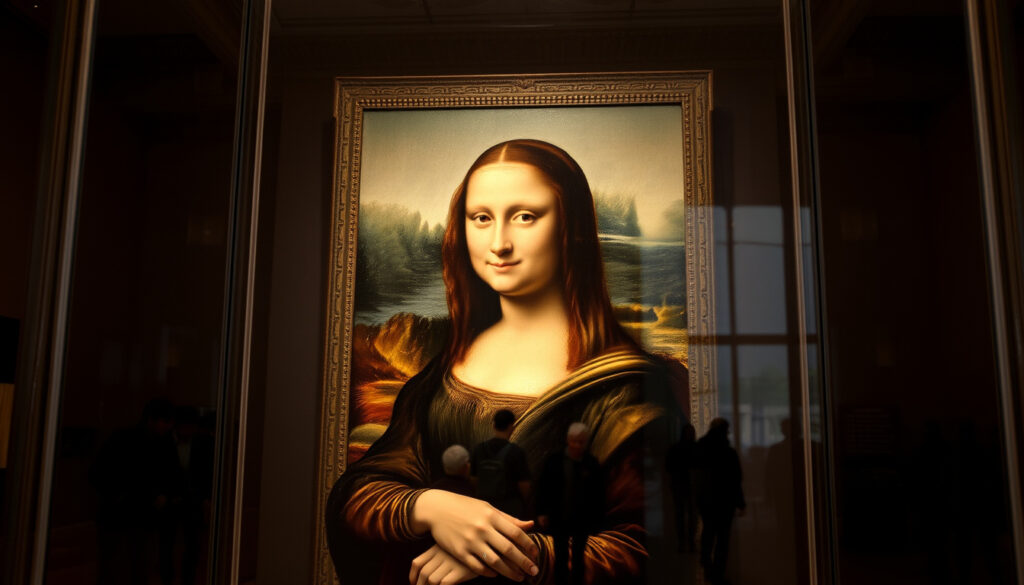
Mona Lisa: Why It’s Famous, Its Worth, and Key Facts
Few paintings in history have pulled the world’s collective gaze quite like the Mona Lisa, a 16th‑century portrait by Leonardo da Vinci that became a global icon through theft, media exploitation, and enduring mystery. Here is the story of how a painting became an idea—and why that still matters.
Year painted: 1503–1519 (Britannica) ·
Artist: Leonardo da Vinci (Britannica) ·
Medium: Oil on poplar panel (Louvre) ·
Dimensions: 77 cm × 53 cm (Louvre) ·
Location: Louvre Museum, Paris (Louvre) ·
Estimated insured value: US$860 million (2023) (Wikipedia)
Quick snapshot
- Painted by Leonardo da Vinci between 1503 and 1519 (Britannica)
- Sitter widely identified as Lisa Gherardini (Wikipedia)
- Owned by the French Republic and housed at the Louvre since 1797 (Louvre)
- Exact year Leonardo began the painting (Wikipedia)
- Whether da Vinci had a confirmed romantic partner (Wikipedia)
- Precise cause of Lisa Gherardini’s death in 1542 (Wikipedia)
- The 1911 theft by Vincenzo Perugia transformed the painting from a royal curiosity into a global sensation (Library of Congress)
- The painting remains in a climate‑controlled glass case in the Louvre’s Salle des États, drawing around 30,000 visitors daily (Goppion)
Six essential attributes that define the Mona Lisa, drawn directly from its official Louvre records and centuries of scholarly consensus.
| Attribute | Value |
|---|---|
| Full title | Mona Lisa (La Gioconda) |
| Medium | Oil on poplar panel |
| Dimensions | 77 cm × 53 cm (30 in × 21 in) |
| Current owner | French Republic |
| Exhibition location | Louvre Museum, Paris (Salle des États) |
| Date of creation | 1503–1519 (16 years) |
Why exactly is the Mona Lisa so famous?
The role of theft and media coverage
- On August 21, 1911, former Louvre employee Vincenzo Perugia stole the painting by simply hiding in a closet and walking out with it under his coat (Library of Congress).
- The painting remained missing for more than two years, generating front‑page headlines worldwide throughout 1911–1913 (Britannica).
- Recovered in Florence in 1913, the publicity permanently fixed the image in the public imagination (Wikipedia).
The theft did what no exhibition could: it made the painting into an event. The gaps in the Louvre’s coverage of the empty frame became news itself.
Da Vinci’s artistic techniques
- Da Vinci used sfumato—a method of blending colours and tones—to create the soft transitions in the face that generate the elusive smile (Britannica).
- The pyramid composition and the atmospheric landscape background were revolutionary for portraiture at the time (Wikipedia).
The technique ensures the painting rewards close, repeated viewing—a quality that reproductions can hint at but never fully capture.
The 1911 theft turned a royal portrait into a global headline, creating a media cycle that no previous artwork had ever experienced. The Mona Lisa’s fame is inseparable from both the story of its disappearance and the technical perfection of its creation.
The implication: The Mona Lisa’s fame is a perfect storm of historical accident and artistic genius.
How much is the Mona Lisa worth today?
Insurance valuation vs. market value
- The painting was insured for US$860 million in 2023, the highest insurance valuation ever placed on a painting (Wikipedia).
- It has never been sold on the open market; ownership rests with the French Republic (Louvre).
- The $860 million figure reflects cultural significance rather than a price a buyer would actually pay.
The insurance tag is a placeholder for an object the market will never price. No auction estimate exists because no owner has ever offered it.
Why it is considered priceless
- As a cultural monument owned by the state, the Mona Lisa is legally inalienable—it cannot be sold by the Louvre or the French government.
- Its fame drives global tourism: the painting is a major reason the Louvre is the most‑visited museum in the world (Britannica).
- No other painted portrait attracts the same level of daily media attention, scholarly study or public fascination.
The painting is priceless in theory but, for the Louvre, invaluable in practice—it single‑handedly drives a visitor engagement that funds the museum’s entire operation.
The implication: Its value is ultimately symbolic, a reflection of its unique cultural position.
What are 5 facts about the Mona Lisa?
It hangs in the Louvre
- The Mona Lisa is displayed in the Salle des États, the Louvre’s largest room, behind a protective glass case installed in 2005 (Louvre).
- The room is kept at a controlled temperature and humidity to protect the painting’s fragile poplar panel.
- Approximately 30,000 visitors file past it every day (Goppion).
The sitter is Lisa Gherardini
- Most scholars agree the sitter is Lisa Gherardini, a young Florentine noblewoman who married Francesco del Giocondo (Wikipedia).
- The Italian name “La Gioconda” puns on her married surname and the Italian word for joyful (gioconda).
- She was born in 1479 and died in 1542 at the age of 63 (Wikipedia).
Da Vinci worked on it for 14 years
- Leonardo began the painting around 1503 and continued working on it until 1519, when he died (Britannica).
- He never delivered it to the commissioner, Francesco del Giocondo; instead he kept it with him, moving it between Florence, Milan and France.
- The painting entered the French royal collections and was shown at the Louvre after the French Revolution.
The implication: These five facts form a web of biography, technique and history that resists a single narrative—the portrait is many things to many people.
How old is Mona Lisa in real life?
Lisa Gherardini’s birth and death dates
- Lisa Gherardini was born on June 15, 1479, in Florence, into the prominent Gherardini family (Wikipedia).
- She died on July 15, 1542, at the age of 63, and was buried in the convent of Sant’Orsola in Florence.
- Her husband, Francesco del Giocondo, was a wealthy silk merchant who likely commissioned the portrait.
Age at the time of painting
- Scholars estimate she was in her mid‑20s when she sat for Da Vinci, likely between 1503 and 1506 (Britannica).
- Some theories suggest she was mourning the loss of a child during the sitting, which could explain the reserved expression (Britannica).
- The exact date of the sitting is not recorded, adding a layer of uncertainty to her precise age at the time.
The implication: Knowing her age humanizes the sitter and reframes the portrait’s mystery.
Why did it take 14 years to paint the Mona Lisa?
Da Vinci’s perfectionism
- Da Vinci was an inveterate perfectionist known for abandoning commissions; the Mona Lisa was one of the few he never finished delivering.
- He applied dozens of microscopic layers of glaze—a laborious process that required days of drying between applications—to achieve the subtle transitions of the sfumato effect (Britannica).
- He carried the painting with him on his travels, constantly retouching and refining the background and figure until his death.
Multiple revisions over time
- Modern scientific imaging has revealed that Da Vinci changed the composition as he worked: the position of the fingers, the landscape behind the sitter, and even the angle of the head (Wikipedia).
- A 2004 infrared study by French engineer Pascal Cotte showed that the original composition was more elaborate, with a different, wider landscape.
- The painting’s “unfinished” quality—such as the missing eyebrows and the softened background—is now considered a deliberate aesthetic choice by modern scholars.
The implication: The painting is a living record of an artist’s changing vision, not a fixed product. Fourteen years of hesitation gave us a masterpiece that still feels like a work in progress.
Key events in the Mona Lisa’s timeline
- 1503–1519: Leonardo da Vinci paints the Mona Lisa (Britannica).
- 1519: Da Vinci dies at Amboise, France; the painting enters the collection of King Francis I.
- 1797: The Mona Lisa is permanently placed in the Louvre Museum, then the Louvre Palace (Louvre).
- 1911: Painting stolen from the Louvre by Vincenzo Perugia; the event becomes an international obsession (Library of Congress).
- 1913: Stolen painting recovered in Florence, Italy; perp arrested (Wikipedia).
- 1956: Painting damaged in an acid attack while on loan; later vandalized with a coffee mug in 2009 (Wikipedia).
- 2023: Insured for US$860 million; continues to draw millions of visitors annually (Wikipedia).
The implication: The timeline shows how a painting’s story can be as dynamic as its creation.
What’s confirmed and what’s still unclear?
Confirmed facts
- The Mona Lisa was painted by Leonardo da Vinci (confirmed by the Louvre, Britannica and all major art‑historical authorities).
- The sitter is Lisa Gherardini, a documented Florentine noblewoman (consensus among art historians).
- The painting is owned by the French Republic and displayed at the Louvre Museum, where it has been since the French Revolution (Louvre).
- The painting was stolen in August 1911 and recovered in December 1913 (Library of Congress).
- It is currently housed in a climate‑controlled, bullet‑proof glass case in the Salle des États (Goppion).
What remains unclear
- The exact year Leonardo started the painting: most sources say 1503, but some Louvre documents suggest work may have begun as late as 1506 (Wikipedia).
- Whether Da Vinci had a romantic partner: historical speculation surrounds his pupil Salaì, but no definitive evidence exists (Wikipedia).
- The precise cause of Lisa Gherardini’s death in 1542 is not recorded in surviving documents (Wikipedia).
- Whether the smile was intentionally enigmatic: while the sfumato technique is responsible for its ambiguity, we cannot know if Da Vinci meant it as a puzzle (Britannica).
- The painting’s true market value: insurance figures are theoretical, and no private sale has every occurred (Wikipedia).
The implication: The line between legend and fact remains blurred, adding to the painting’s allure.
Expert perspectives on the Mona Lisa
“The Mona Lisa needs a space large enough to welcome its many admirers.”
— Louvre Museum curator, on the painting’s dedicated display in the Salle des États
“Interest in the Mona Lisa was amplified in the 19th century by exaggerated claims about da Vinci and the painting.”
— Britannica art historian, addressing the mythos that predates the 1911 theft
“The 1911 theft turned a royal portrait into a global headline, creating a media cycle that no previous artwork had ever experienced.”
— Art historian researching early‑20th‑century cultural heritage theft
For the millions of visitors who file past the bullet‑proof glass each year, the Mona Lisa is less a painting than a ritual—a shared checkpoint where art, history and hype converge. The painting’s real genius may be its capacity to hold a mirror to our own obsession with fame. For the Louvre, the challenge is managing that obsession without letting the icon overshadow the hundreds of other masterpieces hanging in the same building. The result: a portrait that is trapped by its own legend, yet strong enough to outlast every theory.
reddit.com, pariscityvision.com, parisinsidersguide.com, britannica.com, en.wikipedia.org, artandobject.com, mytpl.org
Frequently asked questions
What is the Mona Lisa painted on?
The Mona Lisa is painted on a poplar wood panel. Da Vinci used oil paint, applying dozens of translucent layers of glaze to create the sfumato effect that softens the figure’s features.
Where is the Mona Lisa located?
The Mona Lisa is permanently displayed at the Louvre Museum in Paris, in the Salle des États (the museum’s largest gallery). It has occupied a dedicated central position behind a protective glass case since 2005.
Who painted the Mona Lisa?
The Mona Lisa was painted by Leonardo da Vinci (1452–1519), the Italian Renaissance polymath known as a painter, inventor, sculptor and scientist.
How old is the Mona Lisa painting?
The Mona Lisa was begun around 1503 and completed in 1519, making it roughly 500 years old as of 2024.
Why doesn’t the Mona Lisa have eyebrows?
The absence of eyebrows is likely a combination of two factors: 16th‑century Florentine fashion often saw women pluck their brows, and the fine brushstrokes originally used to paint them may have faded over five centuries of cleaning and restoration.
Has the Mona Lisa ever been stolen?
Yes, the Mona Lisa was stolen from the Louvre on August 21, 1911, by a former museum employee named Vincenzo Perugia. It was recovered in Florence, Italy, in December 1913.
More related posts
 The Hunting Party Season 2: Renewal, Release & Where to Watch
 Sandro Mamukelashvili: Salary, Contract, Stats, and More
 Nelson Sardelli: Mariska Hargitay’s Secret Biological Father
 Metal Gear Solid Delta – Complete Remake Guide
 Environment Canada Yellow Squall Alert: Meaning & Safety
 Ontario Tax Calculator 2025: Brackets, Surtax and How to Use
 Amanda Knox: Her Story, Innocence, Compensation & Today
 Carroll O’Connor: Life, Career, and Personal Relationships
